Echoes Across the Centuries: Lost Portraits of Love Reunite at Maison Chenal After more than two Centuries Apart - Reunited at last
After more than 215 years apart, the portraits of a married couple will reunite at Maison Chenal in the Chenal Heritage Center for History, Culture, and the Arts.
By Bruce Xavier Fung, Curator, Chenal Heritage Center for History, Culture, and the Arts Chenal, Louisiana – January 18, 2026
In the quiet bends of Bayou Chenal, where the waters of Pointe Coupee Parish murmur secrets of forgotten eras, a story of love, loss, and improbable reunion is unfolding. After more than two centuries of separation—spanning the fevered frontiers of the Mississippi Territory, the hearths of New Jersey parsonages, and the bustling auction houses of the modern age—two portraits, twin sentinels of a young family's dreams, are preparing to hang side by side once more. They are the painted likenesses of Major William Gordon Forman and his beloved wife, Sarah Woodhull Forman: he, the ambitious merchant who tamed the wild cotton lands of Natchez; she, the musical heiress whose laughter once echoed through Creole parlors. Their reunion at Maison Chenal is not merely an art historical footnote; it is a mending of time itself, a testament to the enduring pull of human connection.
The portraits' origins trace back to the dawn of the 19th century, a time when America's young republic stretched its tendrils into the sultry unknown. William Gordon Forman (1770–1812), born to New Jersey landed gentry and educated at Princeton, arrived in the Natchez District around 1800 with visions of empire. A lawyer by training, he became a pivotal figure in the Mississippi Territory's economic awakening, introducing Eli Whitney's cotton gin, commanding trade ships like the Augusta and Penelope to New Orleans, and serving as Speaker of the Territorial House of Representatives. His legacy was forged in the fires of revolution; his father, Joseph Forman, a prosperous Monmouth County landowner and merchant, played a vital role in supporting the Continental cause, provisioning troops and hosting key gatherings at the family estate. Joseph's brother—William's uncle—General David Forman (1745–1797), rose to brigadier general in the New Jersey militia, serving directly under George Washington during critical campaigns, including the defense of the Hudson Highlands and the harrowing winter at Valley Forge. Washington himself corresponded with General Forman on matters of intelligence and strategy, entrusting him with reconnaissance missions that helped turn the tide against British forces. This revolutionary fervor coursed through William's veins, fueling his own bold ventures on the frontier. His 1801 portrait, a masterful oil-on-canvas by the Spanish artist José Francisco Xavier de Salazar y Mendoza, captures him in three-quarter length: poised, ledger in hand, his gaze steady with the quiet authority of a man who bent rivers to his will. The faint scar on his cheek hints at youthful duels, while the rich impasto of Salazar's brushwork evokes the Spanish colonial flair of New Orleans, where it was likely painted.
These portraits hold profound historical significance in the post-American Revolution era, a period when the nascent United States sought to forge a cohesive cultural identity from the ashes of colonial subjugation. In the early 19th century, portraiture served as more than personal commemoration; it was a vital instrument for constructing national narratives, blending revolutionary ideals of liberty and self-determination with the practical ambitions of expansion and commerce. William's image, with its ledger symbolizing economic independence, embodies the Federalist vision of a prosperous republic extending westward, where elite families like the Formans translated battlefield valor into frontier fortunes. Sarah's likeness, infused with the domestic grace of a new American womanhood, reflects the sentimental undercurrents that humanized the era's grand ambitions—portraits as talismans of family continuity amid migration and mortality. Together, they illustrate the intimate stories behind the national epic: how post-Revolutionary generations bridged Eastern refinement with Southern reinvention, their painted gazes a quiet assertion of status, resilience, and the democratic dream that every citizen's legacy deserved eternal witness. As scholars note, such works—rooted in the rococo elegance of European traditions yet infused with Yankee pragmatism—helped shape how America perceived itself, projecting stability and sophistication to a skeptical world while preserving the emotional bonds that sustained a sprawling, fragile union.
Sarah Woodhull Forman (1781–1811), the radiant daughter of Reverend John Woodhull—a Continental Congress delegate and Princeton trustee—embodied the grace of the early American elite. Married to William in 1806 in a union of fortunes and families, she brought not only her beauty and a dowry vast enough to fuel his ventures but also a gift for composition, her harpsichord melodies a counterpoint to the frontier's raw cadence. Her portrait, executed circa 1797 by the Danish-American artist Christian Gullager when she was just 16, depicts her seated in ethereal white muslin, a sapphire sash at her waist, dark curls framing a face alive with promise. In her lap rests a book of sheet music, a nod to the airs she penned in her Freehold girlhood. Gullager's rococo elegance, honed in Boston's Federal salons, renders her not as a mere subject but as a muse—timeless, tender, unbreakable. The artist's own brush had immortalized the nation's founding father just a decade later; in 1789, during Washington's triumphant New England tour, Gullager captured the first president's stoic resolve in a life study portrait now held by the Massachusetts Historical Society. That work, with its intimate scale and luminous detail, marked Gullager as a chronicler of the revolutionary generation, bridging the worlds of war heroes and the women who sustained them.
For five brief years, from 1806 to 1811, the portraits graced the walls of the Formans' Natchez home, witnesses to suppers by lantern light, the cries of their infant daughter Sarah Marsh Forman, and dances beneath veils of Spanish moss. They were hung as vows made visible: "So we may never be apart," Sarah is said to have whispered, her fingers lingering on the frames.
Tragedy shattered that vow. In November 1811, Sarah succumbed to childbirth fever at age 30, leaving William a widower with a toddler daughter and a burgeoning legacy in tatters. Resolved to entrust the child to her grandparents in Monmouth County, New Jersey, William set out in October 1812 along the perilous Natchez Trace. He packed Sarah's portrait alongside the girl's tiny trunk—"She must know her mother's face," he confided to kin—while leaving his own as a guardian over his ledgers and lands. Fate intervened cruelly: bandits claimed him near Lexington, Kentucky. Rescued by passing traders, young Sarah and her mother's image pressed on to Freehold, where Reverend Woodhull cradled them both. William's portrait remained in Natchez, a solitary vigil in the upper parlor that would one day migrate to Maison Chenal.
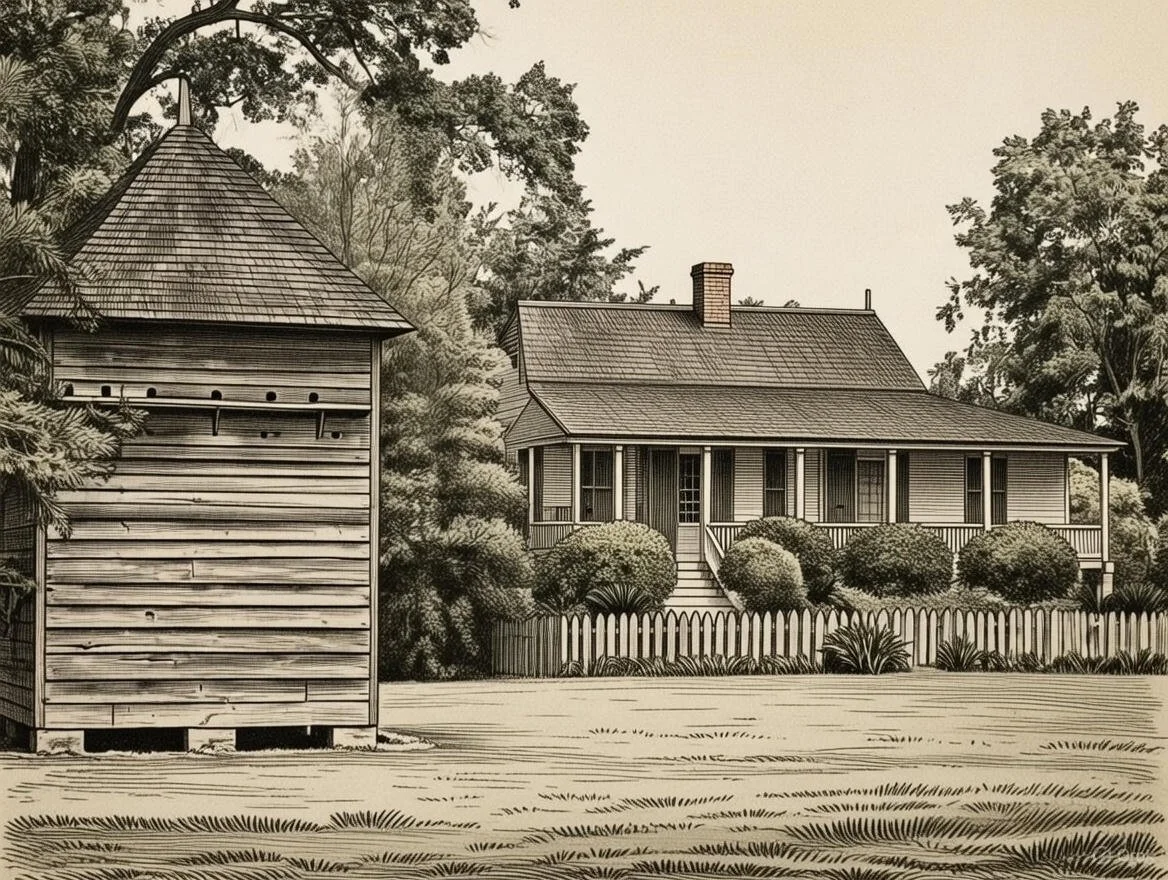
Thus began the 215-year exile. Sarah's canvas wandered with her daughter's lineage—through marriages into Louisiana's bayous, Civil War upheavals, and the quiet handoffs of family attics—until it resurfaced in 2022 at the Schwarz Gallery in Philadelphia, its verso inscriptions a faint genealogy: "Sara Woodhull... married Col. Forman... holding a book of music." William's endured steadfastly in the South, finding sanctuary in the restored 1790s Creole manor of Maison Chenal, relocated to Jarreau in the early 2000s as part of the Lee Holden Collection. There, amid cypress beams and flickering hearths, it has drawn scholars and pilgrims, its empty flank a silent elegy.
The Lee’s a visionary collector couple, moved by the portraits' poignant history, has orchestrated this historic homecoming. In a serendipitous turn this fall, the collector acquired Sarah's portrait from the Schwarz Gallery, securing it in a West Coast collection before committing to return her to Louisiana. "It was as if she chose this path," the collectors reflects. "In that gallery light, her eyes seemed to plead for home—not the distant Pacific fog, but the warm Gulf breeze, the bayou's embrace, back to William after all these years." This decision to loan the portrait indefinitely to Maison Chenal underscores a shared ethos: art as bridge, not barrier, reuniting not just canvases but communities across time and tide, bringing Sarah home to her waiting husband in the upper parlor where their gazes will lock once more.
The journey home begins soon, a pilgrimage freighted with the weight of unspoken vows and half-remembered lullabies. Crated with the reverence due a prodigal—oilcloth whispering against gilded edges as if to hush the centuries—Sarah's portrait will wing its way from San Francisco's chill mists to Baton Rouge's sun-kissed tarmac, then trace the serpentine roads to Pointe Coupee Parish, where the bayou curls like a lover's arm. At Maison Chenal, the Chenal Heritage Center for History, Culture, and the Arts—dedicated to preserving Louisiana's Creole tapestry—preparations unfold with a quiet ache. The upper parlor, with its polished heart-pine floors worn smooth by ghosts of dances past and views of the bayou's lazy, longing curve, awaits like a heart held in suspension. William's frame has been gently dusted, its gilding restored to catch the winter sun in golden tears, every fleck of paint a scar of solitude now ready to heal. A simple ceremony, intimate and unadorned, will mark the hanging: nails driven with a shared hammer's echo—timber yielding like forgiving flesh—perhaps a violinist's rendition of one of Sarah's lost airs, its strings trembling with the quiver of a first breath after drowning.
"This reunion transcends artifacts," says Bruce Xavier Fung, curator of the Chenal Heritage Center, his voice catching on the edge of wonder. "It's a reclamation of stories silenced by time—the love of a husband and wife, fierce as the Trace's wild winds, the resilience of a daughter who carried her mother's gaze through orphanhood's endless night, the threads of history that bind us still, frayed but unbreakable. At Maison Chenal, these portraits will speak anew, their whispers a balm for fractured souls: to visitors tracing their own family migrations through shadowed valleys, to artists seeking inspiration in faces etched with unspoken grief, to anyone who's ever felt the hollow ache of what was lost, the sharp joy of what is found. After 215 years of wandering, of empty walls and orphaned eyes, William and Sarah will soon to be together again. And in their gaze—locked at last, soft as a sigh, steady as the river's pull—we see our own: the fragile miracle of return, the quiet thunder of hearts made whole."
As the bayou whispers on, indifferent to the epochs it has cradled yet cradling them all the same, the Formans' portraits prepare to lock eyes once more—not in the fevered bloom of Natchez youth, but in the seasoned, sun-warmed light of Louisiana's eternal autumn, where leaves fall like forgotten promises fulfilled. Empires have risen and fallen, but love—painted in strokes of longing, parted by the cruel hand of fate, and now whole, trembling on the brink of touch—endures, a defiant flame against the dark. Maison Chenal invites the public to witness this moment, to stand in the hush where time folds upon itself; tours and a special exhibit will open in the new year, a sanctuary for the heart's quiet revolutions. In the words of a poet Sarah might have known: What was sundered by the storm is mended by the dawn, and in that mending, we are all reborn.
For more information on the reunion exhibit or to schedule a visit, contact the Chenal Heritage Center at brucexavierfung@gmail.com All images courtesy of the Lee Holden Collection and private lenders.